Recently I posted this on another blog and thought it might be interesting to those who follow my blog. This was in response to a request for experiences that expats have had with the culture of Ecuador.
Parents of children, when driving, seem to have little regard for the safety of their children, by driving in a non-safe fashion. They regularly do not place their children in properly secured car seats. The children are free to move about the car as it is traveling at high speeds and sometimes in close proximity to other cars.
Although, when they are not driving they are very supportive of family (almost to an excess). It is very common for children to live at home until they are married (which could even involve an age beyond 25). I have seen children still living at home when they are in their 40's and 50's. It is also common for the elderly to live out there lives with their children under the same roof.
It is important, and shows respect, to kiss a woman on the cheek (or at least make the motion) and shake the hand of a man when greeting them. And this occurs when you meet those same people in the future. Family members meeting other family members do this all the time. In fact, they will make a point of wandering around a room making contact with each individual present (at least at a family gathering).
When you are invited for dinner it is expected that you take a bottle of whatever you know that a person drinks even if it costs $80 a bottle. Of course this does not apply to families on a very limited budget. If you do not do this you might never be invited back. This has happened to me. I am curious what others have experienced with regard to this point.
To make noise, is an accepted right. I have experienced a family down the street playing loud music at 3am in the morning in celebration of the day of the mother (I am not sure if this coincides with Mother's Day). These were middle-aged people. This went on for about one hour and then stopped. As we all know, car alarms and barking dogs are very common. Shooting off some sort of fireworks after 12am is not uncommon (at least in Cuenca).
Drivers of cars believe that they have the right-of-way always: Pedestrians beware!
Overcharging seems to be regarded as a norm. This is not strictly where Gringos are involved. I have an Ecuadorian friend who owns several units that he rents in an apartment building. Recently he had to have some work done on his hot water system. The repairman was going to charge him $350 (approx.) for a new water pump. My friend said "No" and then went out and found one for $75. This is not the only incident I have seen of this sort. If they can overcharge and get away with it they will. And they do not seem to think it is rude. Not all, but some Ecuadorians with apartments think nothing of charging exorbitant prices for rent.
Ecuadorians are far more accepting of poor living conditions than North Americans are. They like better living conditions when they experience them, but are still happy without them. We tend to be quite picky, likely because we have become accustomed to a better lifestyle. I have seen people that have dogs where their front patio is littered with dog poop and it sometimes stays that way for several days. One of my Ecuadorian friends has seen this too and was quite surprised why they would put up with such conditions. This Ecuadorian friend has spent a considerable time living in the US. That may have something to do with his perspective on this issue.
Quality customer service is uncommon. Once they have your money in their pocket they don't seem to care much.
Monday, 14 September 2015

Friday, 10 April 2015
Weather in Cuenca
Out of all the months that I have been here so far March is one of the coldest and wettest months of them all. If memory serves January also fell into that category.
When I say coldest I am strictly referring to night time temperatures because the day time temperatures are, most times, quite comfortable (even in March and January). The cold is more noticeable where I live because this is an older house and somewhat well ventilated. As well, there is no heating system (other than for space heaters) as is typical in most houses here in Ecuador.
Almost magically at the end of March the rainy period ceased. So far, April has been very comfortable both at night and in the day. It is overcast today but still very comfortably warm.
I do remember when I first arrived in May that there were some cool nights but not much rain. The days were like Vancouver, BC, Canada summer months: Very warm.
Tuesday, 31 March 2015
First Medical Experience With the Social Hospital (IESS) In Cuenca
Yesterday (March 30, 2015), Nieve and I visited an Intestinal Specialist to see what could be done for my Ulcerative Colitis (UC) as it has been acting up lately.
He said that I would need to have a blood test done and then a colonoscopy.
I knew all of this was not going to result in any benefit for me other than to make sure that I had no cancerous growth occurring in my intestines. The only benefit is to the medical system to convince themselves I was correctly diagnosed as having UC.
Today (March 31, 2015), I had to go in for a blood test. No problem.
There was a very long lineup of people waiting to have their blood tests done. But it was moving quite quickly so no problem.
 |
A little blurry but you get the idea |
I waited a very short time and had my blood taken. The nurse then said you need to give a urine sample ("orina" in Español). So, she gave me a sample container and I left.
I went outside and looked for a place to sit and wait for the urge; however, I started to feel another urge (i.e., to have a bowl movement).
With UC, such an event means a bathroom is needed immediately. The closest bathroom was closed because it was being cleaned. Oh, great!
I looked for another but there were just hallways and no signs regarding a bathroom. I returned to the closed bathroom and asked the attendant where another bathroom was. He said something in Spanish, but it was beyond my level of comprehension. Eventually after me saying "Donde" ("where") several times he pointed in the direction of the lobby. I hustle my tail over to the lobby and madly search for the bathroom.
I finally found one and fortunately it was not occupied. But unfortunately, before I found the bathroom I messed my pants. It wasn't a big mess but enough to be unpleasant.
I entered the bathroom and there was shit on the toilet seat and guess what, there was no toilet paper. Keep in mind this is a HOSPITAL. Can you believe this?!
So, innovating, I used my hand to clean myself up and wash my hand in the sink. Fine, problem solved. Guess what, no soap or disinfectant. Keep in mind this is a HOSPITAL, I think!
Now I know what it must have been like in the dark ages before they had toilet paper and soap. I guess we are really spoiled. Too spoiled because this is a killer for me. I will never be using the IESS hospital system other than for emergencies while I live in this country. And I may reconsider even using the IESS hospitals for that.
If they cannot even maintain their bathrooms properly it doesn't give me much faith in the rest of the system.
The good news is the other hospitals in this country are maintained as one would expect in a civilized country. Mount Sinai and Hospital del Rio are examples of private hospitals that I know of and they are both maintained as we would expect.
However, if I decide to pay as I go and an emergency surfaces, the cost could be significant. So, if I am to stay in this country I guess I will have to use the IESS hospital, but only for emergencies as do other expats. Here's hoping I never have to do that or at least not for a long time so as to give the system a chance to improve.
Getting back to the urine sample, I managed to accomplish this task. So, in my uncomfortable state I returned the sample to the place for analysis. The attendant says "Oh, you need to provide a stool sample" (in Spanish). First time I have heard this. I wish I had known that before as I could have taken care of that at the same time I did the urine sample.
The nurse who took my blood gave me one sample container not two. Great! Well, I was done for the day. The stool sample was going to wait until later.
ASIDE: Ecuadorians refer to "poop" as "caca". The official Spanish appears to be "Heces" (as indicated on the medical sample tag).
Now that I am home and showered I feel much better. But, changes are definitely required for me to be happy.
Back in the hospital, in my frustrated state, I was ready to pull the plug and move back to Canada right then and there. But, now that I have had time to regroup, there are other options to explore here before doing that. Another reason is that I would rather not have to put Tiger through a long return trip to Canada as it was pretty tough on him on the trip down to Ecuador.
UPDATE APRIL 2015:
I had occasion to return to the IESS hospital and this time the main bathroom on the main floor was open and it was very clean and contained all the necessary things we are accustomed to (soap, toilet paper, etc.). So, I guess the poor conditions that happened to me were just an unusual circumstance that I hope I never have to repeat.
Wednesday, 18 February 2015
Dogs and Car Alarms!!
Dogs are very prevalent in Ecuador or so I have heard. Since Cuenca is the only place I have spent much time as of yet, I can only be certain of the state of dogs and car alarms here.
In Canada, most people keep their dogs inside at night. That is not the case in Cuenca. As a result, you can expect to hear dogs barking at night.
Last night was a case in point. Between car alarms going off and dogs barking I did not have a very good sleep.
I have stayed in other parts of the city and can attest to the fact that there are areas that are more quiet than others. Also, I would think living in an apartment that is 6 or more floors up that the affect of noise would not be as great.
Some apartments have double-paned windows which help to reduce noise as well.
On another note regarding pet care, people do not treat their dogs the same way we do in Canada. They often do not get proper veterinary care.
There is a dog that lives across the street from us that has severe hip dysplasia. He looks like he is in pain most of the time, but the owners do nothing.
Coco, my girlfriend's dog, was in a fight with another dog and suffered some nasty abrasions to his nose. The wounds were left to heal on their own.
Most dogs are infested with flees and left that way. And they rarely ever get a bath so they smell.
Dogs are, typically, kept in a confined area at night, but are allowed to roam the streets during the day.
Since about two weeks ago, dogs roaming the streets seems to be on the decline. This could be as a result of the city implementing a much needed law that would result in a stiff fine ($300 - $1000) if an owner's dog is caught wandering the streets. Whether this law will be enforced or not remains to be seen.
Hopefully we will see less poop in the streets as well. I am not trying to indicate that there is a lot of dog poop in the streets, but you do have to watch your step.
My girlfriend has two dogs she rescued from the street. She feeds them table scraps (if there happens to be any) and dry dog food. They each get a cup full of dry food twice a day. And most of the time they are hungry. I guess it is better than them trying to fend for themselves. They seem to be happy and do not look malnourished.
I have been trying to teach them not to bark at passing cars, dogs and people and have had some success. Since I am not allowed to use a shock collar I have been throwing water on them whenever I catch them barking. It stops their barking immediately. The problem is it is difficult to catch them in the act all the time.
Since I have been living with her, and knowing that I dislike her dogs barking, my girlfriend makes a concerted effort to chastise them.
I have heard of a collar that vibrates instead of applying a shock. I may give that a try if I can find one that is not too expensive.
The other problem is finding some way to stop other people's dogs from barking. The owners don't seem to care if their dogs bother anyone.
Some nights I feel like poisoning a piece of meat and throwing it in the yard where the dog lives. I don't think I will ever go that far. But, I may invest in a gun that can spray a strong stream of water. That might help.
As to car alarms there is not much to say other than I don't think Cuencanos should have ever been given car alarms. They seem to have no clue how they work.
I was walking in the street yesterday and this guy was wandering around his car opening and closing the doors in an attempt to get the alarm to cease. I don't suppose it occurred to him that he had to depress the button on his keychain to deactivate the alarm after making sure the doors were closed.
There is an older person living across the street from us. Almost every time he uses his car he opens the door before disabling the alarm and of course the alarm goes off. And, it seems to take him a few minutes to figure out that he should push the deactivate button. Very irritating especially when he does this at night.
I hear car alarms going off all over the city every day and sometimes during the night. Fortunately, most of them, except for the guy across the street, are in the distance.
One other source of noise that is not great is motorcycles that have no muffler. Young people love that wild and nasty sound.
If anyone is really sensitive to noise you might want to consider another locale than Cuenca. I think this is one reason why some expats live in small towns like Cotacachi. However, the disadvantage in living in a small town is there is not much to do.
Don't get me wrong: Most of the hours in a day are quiet. But when the noise happens it is not pleasant.
Monday, 26 January 2015
Tasty And Inexpensive Food
There is a nice little restaurant close to where I shop for groceries at the Supermaxi. I go there frequently for lunch (in Spanish: el almuerzo) as it is very tasty and filling. The cost is $2.75 for all that you see in this photo:

And another place I really like is Monte Bianco. They have absolutely wonderful birthday cakes and a very good thing I treat myself to once in a while. It contains wonderful fruit and two different flavours of ice cream. Yummmy!!!
 |
| $3.00 |
Shopping at the Mercado
This past Sunday we visited the Feria Libre mercado here in Cuenca.
We had been there a couple times before but did not do as much shopping as we did this time. We came away with approximately $50 worth of groceries enough to last for a few weeks in terms of vegetables and fruit. In terms of meat, about 6 or 7 days. And in terms of rice, about 5 months.
A good portion of liver (for 3 people) cost $2. Three pork steaks cost $2.20. About 6 yellow platanos cost $1 and 6 green platanos cost $1. One large papaya - $1. One large pineapple - $1. Three avocados - $1. One large melon - $1. Ten or twelve onions - $1. One kg of cheese - $2. A huge bag of rice - $14. Potatoes - $2. And a number of other things.
Aside: For some reason I always want to pronounce "platanos" as "plantanos" (for which I am consistently corrected).
Aside: Yellow platanos are sweet and green platanos are not. Green platanos are sometimes used as a replacement for potatoes. Yellow platanos can appear with almost any meal, are usually fried and are very tasty.
Aside: Green platanos are used to make something called "Balon". You cook the platano and then mix it with cheese ("queso" in Spanish) and sometimes add some cilantro and then roll that into a ball and toast it. Very good. Some Ecuadorians use this as their breakfast.
 |
| Papaya, potatoes & Rice |
 |
| Pineapple, Bananas & Platanos |
But there are still reasonable prices to be had in Supermaxi especially when considering how much some things cost back in Canada.
What I have stated above is the PRO part. And now for the CON part.
Unless you are prepared to make many trips to the mercado you will end up trying to cart a lot of heavy bags around while you buy what you need. There are no handy carts like you have at a grocery store (like Supermaxi here in Cuenca). There are no carts to carry your goods out to your car or taxi. And this particular mercado is not anywhere close to as clean as the grocery stores are. In fact, I haven't seen any mercados that are that clean, although there is mention of one that is supposed to be quite clean.
I guess I like my creature comforts. Although it is quite interesting seeing all the goods for sale in one of these mercados.
UPDATE as of February 18, 2015: Today at a deli I purchased 0.28kg of pork in a thin, wide strip for $2.39 and 0.73kg of smoked pork loin for $11.54.
A few days ago I purchased one large yellow pepper for $1 at a mercado in El Centro. I was subsequently told that should have been $0.25. The lady at the mercado gave me a smug look when I asked for a bag to put the pepper in. Talk about "gringo-gouging"!
I also purchased 1 kg of beef in a thin wide strip and paid $2.25. I was told this should have been $1.
It's taking time but I am getting used to what things are suppose to cost. It is much easier when shopping at a grocery store.
Sunday, 11 January 2015
Technology Group Meeting
These days I am needing something more to occupy my time rather than just sitting at my computer all day.
So, I decided to see if there was any interest in forming a technology discussion group.
There is a website (one of many) that expats use to keep tabs on what is going on, what services are recommended, and what things various expats have for sale (including apartment & house rentals). This website is Gringopost. It is a very good resource which I monitor almost on a daily basis.
I posted a meeting date at a popular restaurant (Fabiano's) in El Centro last Thursday evening. Early Friday morning the responses started coming in. Fabiano's has a limit of 15 people per event. I have already exceeded that and have to suggest to additional responders that I will include them in the next get-together.
Out of the respondents there appear to be 3 Ecuadorians that will be attending. That is very good.
As a result of my posting, I have touched bases with a person whom is very interested in 3D printing. This is a technology that is very new to Ecuador if it even exists here yet. It is possible this meeting may prove very lucrative. Time will tell.
If this meeting proves to be beneficial I am going to see if there is interest in forming a group to discuss science issues and associated philosophies.
UPDATE - January 26, 2015: The Technology group meetings have been very enjoyable and typically attended by at least 6 people.Sometimes there are questions on how to do some particular function or get around some problem and other times they can involve a discussion. I plan on continuing them as long as people are interested.
UPDATE - March 31, 2015: The Technology group meetings have ceased due to lack of significant interest. However, I managed to make one contact who has turned out to be a very good friend and that has resulted in many interesting conversations. We have also been working on a new website design for a real estate friend of his. We are hoping to make this website the best that exists in the city.
Monday, 17 November 2014
Vilcabamba
Before I came to Ecuador I did a lot of research on possible destinations to live. Vilcabamba was one of those destinations.
I had previously read about how wonderful this area was. However, I had also read that it was populated by 'hippy-types' and people who are a little peculiar in their nature.
I recently came across a website posting that was very illuminating and, if true, would make me think otherwise about this being a nice place to live and mainly because of the expats that have made it their home.
The article is very well written. Here is the post.
I am still happy where I am living, but try to keep an open mind.
Tuesday, 11 November 2014
Internet Service
Something we can't seem to do without these days: The Internet.
As you may have read on other posts, the Internet service in Ecuador is not great. Fortunately, most of the time it works well.
The cost is approximately the same as what it is in Canada. We pay $20 (SP: vente dolares - $20) per month for 5 Mbps (called Megas in Ecuador). There are various other speeds available both slower and faster. The faster speeds get quite expensive.
The main suppliers of Internet service are:
1) TV Cable
2) ETAPA
3) PuntoNet
TV Cable is regarded as the best of the bunch by most expats. I only have one comment from an Ecuadorian that ETAPA is better (from his experience).
Even though TV Cable is regarded as the best of the bunch, their technicians seem not to be trained very well.
Over the last few months we have experienced an intermittent signal quality problem. Sometimes our Internet service is out for 2 or 3 hours at a time and this can occur multiple times per week. Each time the techs come to check it out they never manage to resolve the problem.
On one visit the techs actually determined that there was indeed a signal strength problem and that it was external to the house. On the next visit (different techs), they installed a different splitter as if to say the problem was inside the house.
What amazes me is that they do not seem to record what is done on each visit so that the next set of techs can save themselves some time. Or maybe the case is that they do not believe the test results of their predecessors.
I know for sure the problem is external (SP: fuera - meaning outside, they also use "afuera") to the house, but convincing the techs of that, with my broken Spanish, is not easy.
The techs that actually determined the problem was external to the house examined the signal strength on the pole outside the house but did not do anything to resolve the problem and never returned to attempt a repair.
Based on another earlier analysis I would guess that the some techs (or maybe all of them) are not well trained and therefore have great difficulty resolving complex problems. Hence the reason for the problems going on and on.
Who knows if we will ever get this problem resolved.
UPDATE (Jan 11, 2015): They finally resolved the problem in mid-December. We have not had an outage since that time.
I had called them, once again, in December, and they sent out some other techs. This time they also determined there was a signal strength problem external to the house. Finally!! They told me they could not fix the problem, but that it would be fixed later that day.
I don't know when they came or what they did. I was never given any kind of report or phone call. Regardless, the problem seems to be resolved.
Around Jan 6th, we experienced a very bad connectivity problem. This problem was not the same as when the cable modem kept dropping the connection. This time it was severe "packet loss".
"Packet loss" is basically traffic from and to your computer that gets lost in transit. This "packet loss" manifests itself as your inability to connect to a website (or some other Internet-based service) or where your web-browser takes an excessively long time to present the website webpage content you are attempting to view.
This problem lasted for a good portion of the day (6 or 7 hours). The next day I saw the same condition for about 1 hour. Since then our Internet service has been fine.
Here's hoping it stays that way.
Some people have suggested purchasing a router that will fail over to a backup Internet service if your main one goes out. Such routers are not that expensive (roughly $70). However, it means you have to double the cost of your Internet access charges because you have to maintain Internet service from two different Internet Service Providers (ISPs). This is certainly an option if the Internet is that critical to your life.
Another thing to consider is purchasing a "Business Service" from one of the ISPs. This type of service costs more money, but the ISPs tend to respond to problems in a much more efficient manner than if you purchase a standard Internet connection.
Tuesday, 14 October 2014
IESS - Medical Insurance in Ecuador
Since I now have my Cedula I am eligible to apply for medical insurance in Ecuador. The medical insurance I am applying for is through Ecuador's Social Security system (i.e., not private medical insurance).
If you work in Ecuador you automatically pay into the Social Security system. For expats, we are required to pay $72 per month. Bo and Linda mentioned that their's cost $81.63 ($11.59 more for Linda as a dependent). This includes full medical, dental and optical. I think there are some exceptions like cosmetic surgery that are not covered. And I think that some medications are not covered or not completely covered. But since I am new to this, the specifics will have to wait until later.
So, the other night Nieve helped me sign up online. The IESS website is in Spanish so it was a great help in having Nieve along for the ride. In fact it was even difficult for the both us to find the correct link in the menu system to make the application. To help with that go to the IESS website, look at the bottom of the page and hover your mouse pointer over "Personas Independientes" and then select "Generar clave por primera vez". Then follow the prompts. And of course you will need your Cedula number to complete the application.
I signed up on Oct 12th. Nieve says I will have to start paying next month. I am not sure how this payment will take place but I will update this page when I find that out.
UPDATE - January 26, 2015: The payments are happily come out of my Banco Pichincha account here in Cuenca. Fortunately, I have not had cause to avail myself of the IESS services.
Wednesday, 1 October 2014
My First Birthday In Ecuador
On October 1st I turned 61. My first birthday in Ecuador!
Nieve took me out to one of our favourite (and expensive restaurants) "Zircus". She must have called ahead because when we arrived the table was encircled with rose petals.
We didn't order anything. She knew what I liked and had pre-ordered it: Steak and Langostina along with quite a number of side-dishes, plus one of our favourite wines: Trapiche Malbec.
Zircus is a fairly new restaurant in Cuenca. It is attached to a new hotel which is located next to the Estadio Alejandro Serrano Aguilar near Ave de Solano.
The least expensive nightly cost in this hotel (according to their website) is $103.70 USD (including tax). The rooms are quite spartan looking as is the restaurant (i.e., if you are looking for a cozy place you might consider an alternative).
In previous visits to this restaurant it has typically cost us $45 for the two of us which has included a glass of wine with our meal. This is one of the most expensive meals I have had in Cuenca.

Upon our return to the house we were greeted by her youngest son (Xavier) and his wife (Veronica) and in-laws who wished me a happy birthday.
A few days later, Xavier and his wife showed up with a very yummmy birthday cake.
Wednesday, 24 September 2014
Cedula - Ecuador's Identity Card
I obtained my Cedula (Ecuador's Identity Card) on September 1st, 2014.
- You can enter the Galapagos for $6 (as if you were a Nacional); instead of the $100 that tourists pay.
- You can get refunds on all the taxes you pay after you turn 65.
- You can get 50% discounts on airfare in Ecuador (and possibly outside Ecuador).
- You can apply for Social Medical Insurance at a cost of $70 per month.
There may be other advantages I am not aware of.
To obtain my Cedula, I had to first obtain my permanent Visa (which I have talked about in an earlier post). After the permanent Visa is obtained you need to apply for the Certificado de Empadronamiento. You obtain this document at the Ministerio de Relaciones Exteriores (the same place you apply for your permanent Visa). Incidentally, they speak very good English so there is no necessity to hire a facilitator or a lawyer.
You need the following paperwork to obtain the Certificado de Empadronamiento:
- A notarized color copy of your Birth Certificate (long form).
- The application for the Cedula (you can fill this in English or Spanish)
- A color copy of your passport
- A color copy of the permanent Visa stamp in your passport
- Marriage certificate (if you have been or are married)
** The Cedula application form can be obtained from the Ministerio de Relaciones Exteriores website which was http://cancilleria.gob.ec/wp-content/uploads/2013/07/formulario-cedula-julio2013.pdf at the time of my application.
I was told by a person at the Ministerio de Relaciones Exteriores that I would need the following documents to present to the Oficina del Registro Civil in Parque Louis Cardero (Cuenca):
- A notarized copy of your Cedula application
- The Certificado de Empadronamiento
It turned out that the Oficina del Registro Civil only wanted the Certificado de Empadronamiento and to look at my passport (and nothing more). So, I spent $11 for the notary that I did not have to spend.
I went to the Oficina del Registro Civil, handed in my Certificado de Empadronamiento and waited for my number to be called (roughly 3 hours). I took some stats and it takes them .7 minutes to process one applicant. This involves taking your photo and taking your fingerprints (both hands) and to enter some information into their system.
In my case it took a bit longer because when the person went to enter my information they could not enter North Battleford, Saskatchewan because that data was not available for them to select. So, they had to send an email to Quito (where this data could be input) and I had to wait an additional half-hour for this to occur.
Then I waited another half-hour for them to call my name to receive my Cedula. They get you to look it over to make sure the information is correct. Then you give it back to them and they put the official stamp on it and you are done.
Some people say you need to prove that you are single by obtaining a notarized statement that you are single. If this used to be required it is no longer necessary.
Also I would suggest that in your Cedula application form you state that all you have is a basic education. Otherwise, you may have to produce an authenticated document of your education. Why bother complicating the process? There is no advantage that I am aware of in stating anything but a basic education.
Saturday, 20 September 2014
First Experience With A Dentist
Before I came to Ecuador I had noticed some minor discomfort in my teeth. So, I thought I would take advantage of the cheaper costs, that I had read about, once I arrived.
As I was busy with a lot of other activities I just never managed to find the time until the pain started to get a lot worse.
Nieve recommended a dentist that her family had been using and whom they all thought highly of and that he spoke english.
The first visit involved an x-ray which cost $15. On the second visit, the dentist told me he could not see anything wrong in the x-ray. So at his suggestion he added a coating to three of my teeth as I was experiencing hot and cold sensitivity. This cost was $45. This seemed to help. But there was still this overall dull pain.
So in the next week and I went back to see him again. He took another x-ray and still could not see anything. I told him there was pain in the gum below the tooth. So he hummed and hawed as if he did not know what to do next. Then suggested it might require a root canal or tooth removal. Since he could not determine what to do he did not charge me anything for this visit. As I had heard of another dentist via the gringo Internet I decided to get a second opinion. I was able to get an appointment the same day.
Her name is Dr. Grace Ordoñez. As soon as I had described the symptoms, Grace immediately prescribed a pain killer (800mg tablets of Ibuprofin), a course of antibiotics (Ciproflaxin) and made an appointment for the next day with a dentist who specializes in root canals. She said these things can get very painful. Grace charged me $10 for the consultation.
The next day at 9:30am, I had my first session with Dr. Jorge Espinosa which would be the first of three sessions. I wanted him to give me gas as I hate needles but apparently they do not use gas in Ecuador.
The first session went with very little problem. However, the second session, two days later, involved a fair amount of pain despite the Novicaine. He then prescribed a heavy duty pain killer (called Ketoralac Trometamina) which I read about on the Internet. Apparently this drug has some severe side-effects and has been banned in a number of countries. Despite this I gave it a try but fortunately observed no negative symptoms.
Now it is two days after the second session and I no longer have to take any pain killers and no longer feel any pain.
I do not know what he has in mind for the last session. Perhaps all he needs to do is install a more permanent filling. My next appointment is next Wednesday (Sept 24th). I will add an update when that session is complete.
The total cost of the three sessions on the one molar will be $330. As I have never had a root canal before I do not know what the cost would have been in Canada.
I was visiting a couple of Canadians who are in the process of moving here and one of them had been to visit the same dentist. He has two teeth that need to be cut down and then capped. Apparently this is going to cost him $800 per tooth.
If I had been able to acquire the Social Security Hospital insurance soon enough this would not have cost me anything more than my monthly medical insurance cost of $70 per month. Unfortunately, it takes three months after you acquire your Cedula (National Identification card) before you can take advantage of the system or so I have been told.
UPDATE: The root canal is finished and the pain is all gone. For some reason the Orthodontist that did the root canal does not do fillings so I had to go back to the other dentist (Ruth Ordoñez). Upon visiting her she stated that since the molar has 3 fractures and not a lot of structure (which I can confirm from feeling it) that I need to return to the Orthodontist and have him put in a "base" which then Grace can install a post and crown. The estimate was $320.
The "base" has now been put in and feels just like a filling. However, two days after getting the "base" installed, part of it fell out.
My next visit to Grace is scheduled for this Monday (Oct 6th) and I am sure she is going to say that it is not good enough for the crown and I will have to return to the Orthodontist to get the problem corrected. I will post the next part of this commentary as "Update 2".
UPDATE 2: Even though some of the "base" had fallen out Grace said that it would be OK for the addition of the "post". However, upon starting to work on the tooth, Grace mentioned that it smelled bad. I also have noticed a small amount of pain when applying pressure to the tooth. So, Grace made another appointment for me to go back to Jorge Espinoza.
Jorge examined the tooth and determined that the tissue was just inflamed. He prescribed a 5-day course of an anti-inflammatory called "Arcoxia" (120mg) to be taken once every 24 hours. He gave me 2 free tablets and did not charge me anything for the visit. The other 3 tablets cost $11.43 including tax.
I am to complete the course of anti-inflammatory and then make another appointment with Grace to have the "post" and crown installed.
In addition to the work Grace was doing she examined my other teeth and reported that there were two molars on the left upper side of my mouth where the fillings needed to be replaced. I hadn't had any dental work done in about 25 years so I guess it was due. She replaced the fillings for $125. There were 5 fillings in 2 teeth. It took roughly 3/4 of an hour.
Stay tuned for UPDATE 3!
UPDATE 3: I re-visited Grace and she mentioned that the smell is still present. I am not surprised as an anti-inflammatory drug is hardly going to get rid of a problem like this. She thinks that the tooth has a fracture which is allowing blood to come up into the tooth where bacteria can get at it thus causing the smell. She showed me some black material she extracted from my tooth which could have been blood. Given that this is the case she says the tooth needs to be removed. So, unfortunately, all the money I have spent on this tooth has been wasted.
Since the bad taste and smell have only been present for the last 4 or 5 days, I suspect that during the root canal Jorge may have created the fracture. But, there is no way to prove this.
Grace also said that when the tooth is removed that a bridge should be installed to prevent the bottom tooth from growing up into the hole where the old tooth had been. The bridge would cost roughly $800. Hmmm!!!
Nieve's daughter says that the cost of installing a bridge is way overpriced. She is going to ask her dentist what the cost would be.
UPDATE 4: I had the tooth removed today - Oct 28th ($42.80) and I am now taking antibiotics (Amoxicilinia 500mg - $3.24 for 21 caps) and a pain killer (Motrin 600mg - $7.49 for 14 tablets).
The tooth definitely had a fracture. You could see it once it had been removed. You could also see black spots along the fracture area.
Grace also said that because the fracture was vertical in orientation that is why it did not show up in the X-rays.
Thursday, 11 September 2014
Galapagos Adventure
We just returned from a great adventure in the Galapagos. Just for your reference the Galapagos is a small group of islands 1.426km from the coast of Ecuador and that is part of Ecuador.
There are two airports in the Galapagos. One is on the island of San Cristobal and the other is on the island of Baltra.
We started our adventure at the airport in Baltra.
Baltra is a small island that is rough and dry with low-lying brush and cactus's. There isn't anything else on the island other than for the airport and a small port on the south of the island where the water taxis wait to take you across to the main island of Santa Cruz.
 |
 |
| Leaving Baltra |
Early in the day we came across these marine iguanas having a siesta.

That night we went walking and came across a restaurant/bar that had some very lively Ecuadorian music and dancers in traditional dress.

The music had a very inspirational effect on Nieve. She loves her countries music and so do I.
Our accommodations were through a friend of Nieve's who runs a small boarding house along with her profession as a lawyer.
The cost was $50 per day. The room was very nice, not hotel quality, but very nice and clean. However, there were a couple of problems.
On our first night we discovered ants crawling on the floor in our apartment and some even managed to get into our bed. I killed around 15 to 20 and there were still more. The next day we pointed this out to Nieve's lawyer friend and she had the problem resolved that day. Another issue was the shower. There was no way to set the shower so that it was a constant temperature so you had to keep adjusting it during the shower session.
Another annoyance was that you had to use the air conditioner as there wasn't much air movement to keep the humidity at bay. The air conditioner created a cold draft which did not make for a great sleep.
We did check on the prices of some other accommodations and found that the hotels facing the ocean could cost as much as $328/day. But there are accommodations that are less. We found one hotel that looked good for $150/day. Everything is overpriced in Galapagos, including meals, cruises (even day cruises), taxis, and clothing. There is no doubt this is a tourist town.
There are three large islands and a fair number of small islands. We visited all three of the largest islands and a few of the small ones.
On the second day we went on a scuba dive off two different islands (Bartolome & Santiago) just north of Santa Cruz. Once again we had to traverse the extremely rough road going from Puerto Ayora to the north of Santa Cruz so that we could take the dive boat to our dive location. This time the ride was not so rough as the truck we road in had much better shock absorbers.
The boat ride took approximately one hour and some of the other divers were not doing so well from the bouncing of the boat through the rough waves. Nieve wasn't sure whether she would get sea-sick or not so she took an anti-sickness pill which one of the other divers were kind enough to give her.
 |
| Rocky Bartolome Island Where We Had Our First Dive |
 |
| Nieve |
They held her secure by the boat while trying to get her comfortable but it was just too much for her so she spent the rest of the day snorkeling which said she enjoyed very much. She is still adamant about learning how to dive and in a more controlled environment like a swimming pool I think she will do much better.
My dive was very good. We saw many white-tipped sharks and one hammer-head. The white-tipped sharks were only about 4 meters away from us. They were very casual just cruising around the reefs looking for the next meal I guess. There is an abundance of food for them on the reefs so there is no danger of an attack on a human unless you managed to cut yourself and were loosing blood into the water.
The cost of the scuba diving trip was $330 for the two of us. They did not offer to refund any money because Nieve was unable to dive.
The next day (Aug 9th), we hired a taxi for the day and had him take us to various spots on Santa Cruz at a cost of $150.
The tortoise population was considerably threatened for many years and as a result there are various facilities that have been built to increase their numbers by raising them in protected environments. The following photo is from one of these facilities on Santa Cruz.
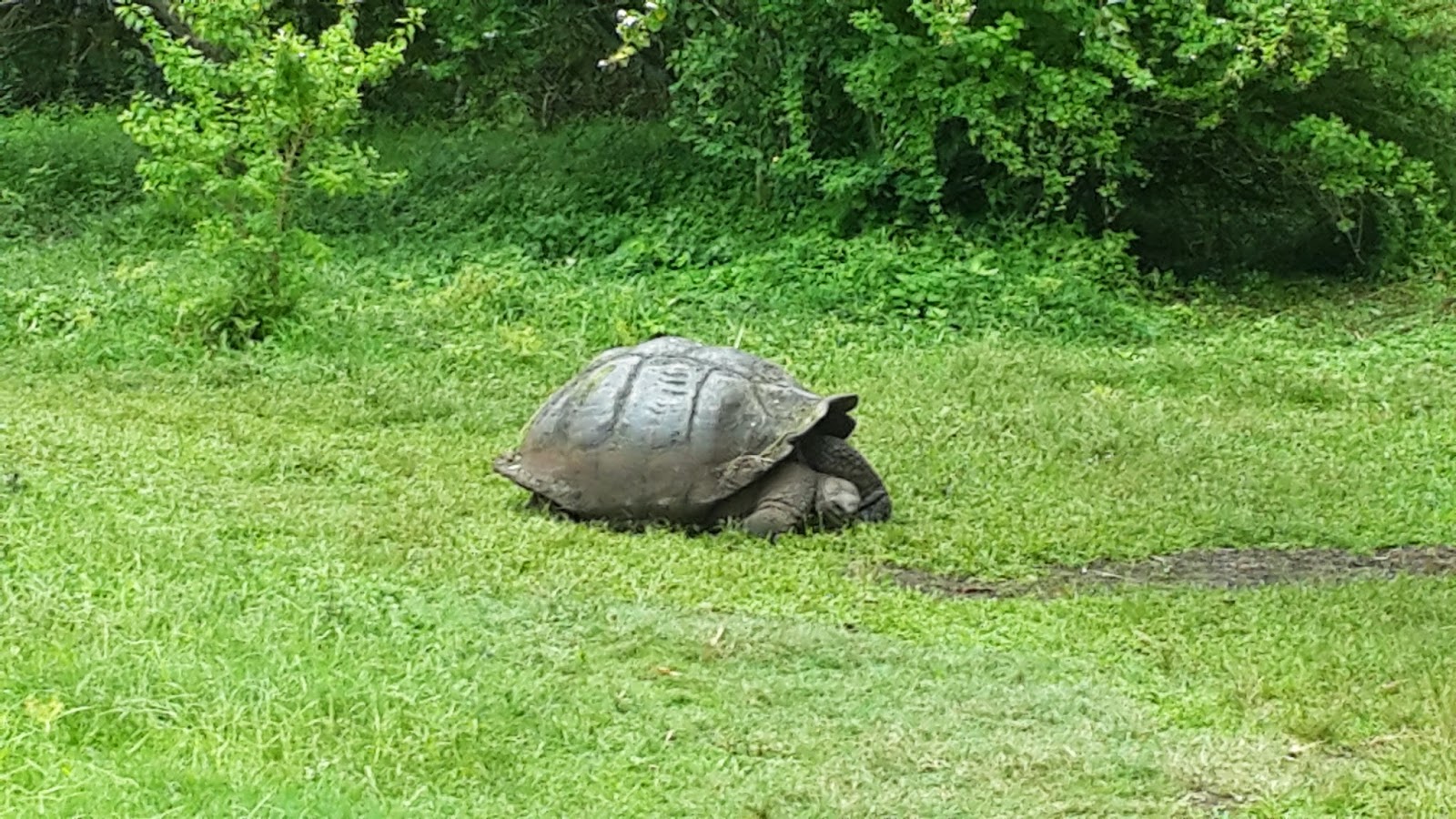
The Spanish word for tortoise is tortuga. This tortuga is approximately 150 years old.
Next we visited a very beautiful beach where we went swimming. The water was a bit cool to start with but once accustomed to it it was fine. We found that as we moved around in the water we could feel warmer and cooler spots. This effect could be the waters of the Humbolt current (coming from the Antarctic) and the warmer currents coming from the north intermingling.
On the way to the swimming beach we encountered this marine iguana and many others.

Once back into Puerto Ayorta we looked into the possibility of a 3 or 4 day cruise. There were many different prices, different locations that were visited, different levels of luxury on the boats, and different types of boats.
Because I was concerned about Nieve's ability to cope with the a rocking boat, we were mostly looking at a catamaran-style boat. Catamarans have two hulls and this adds to the stability (i.e., they do not roll around as much). However, Catamarans are rated in the 3rd class (called Luxury) and 4th class (called First Class) and as a result are more expensive. The only price I can remember was $1200/person for the 2nd class (called Mid-range) for a 3 day cruise. Prices like this can only be obtained if you ar already in the Galapagos. If you book before arriving you will be looking at a much higher figure.
 |
| Example of one of the many catamarans available |
After reaching Isabela we were taken ashore and had a chance to do some snorkeling before boarding a tour truck which shuttled us to various sites on the south part of the island.
Our snorkel equipment, unfortunately, was less than adequate (equipment supplied by the day cruise agency). One point of delight was Nieve's experience swimming in the ocean with a couple of sea lions. That experience wasn't new for me.
The tour truck was OK except that in wearing my hat I did not see the low wooden cover over where we were to sit and waked my head a considerable blow resulting in a bit of a gash. I guess these trucks are not made for tall people.
We were transported to various locations where we saw pink flamingos and another sanctuary for land tortoises (in various stages of growth).
After seeing much of Santa Cruz, Isabela proved not much different and was not that interesting to me. Most of the wildlife that exists on this island looks very much the same as other islands, but in fact is quite different genetically and I would imagine if you observed them closely you would see the differences.
The next day (Tuesday) we took a leisurely day part of which we used going to a beach close to Puerto Ayorta. The beach was long and beautiful and the day was sunny and enjoyable.

Wednesday, we looked into the possibility of another day trip to an island called Floreana (an island southeast of Santa Cruz). Unfortunately, none of the tour boats were going to Floreana until Aug 14th (today being Aug 12th). We had already spent a fair amount of time on Santa Cruz and seen most everything it offers so rather than try and find something to do for another day while we waited for the boat cruise we decided to go to San Cristobal: An island we had not seen yet and the island we had to get to catch our flight back to the mainland.
So, on Aug 13th (Wednesday) we made a very rough, 2.5 hour boat trip to San Cristobal ($60 for both of us).
ASIDE: One thing I should say about these boat trips is that the best place to sit is near the back end of the boat. You will experience far less roughness than if you are near the bow of the boat. Don't sit at the very back of the boat either as you may get wet if the boat has no splash curtain (which some boats do not have).
After arriving on San Cristobal we strolled around the town and found an art store with some very beautiful artwork.

We soon discovered that San Cristobal was a very boring island to spend any time on as there was very little to do and there are very few good restaurants. In retrospect we should have stayed on Santa Cruz. I had done some research before coming to the Galapagos, but had not seen any mention of San Cristobal as being a dull island to visit. Anyway we were here and had to make the best of it.
We found another place to stay for $50 per night. As with our apartment on Santa Cruz, this place was not on the malecon. It was a few streets back from the ocean. They originally wanted $60 per night, but when they noticed I was interested in going to check the hotel across the street they lowered the rate to $50 per night.
The place was small but clean and had a much better shower than we had on Santa Cruz.
The next day (Aug 14th) we rented a couple bikes for half a day ($20 for both of us) and rode around the town (Puerto Baquerizo Moreno) and made our way to another beach (La Loberia).

Near the beach there was a place where we got very close to one blue-footed boobie and took a few photos but the best one turned out a bit blurry. Nonetheless here it is and if you look real close you can see it's blue feet.

We also visited a facility called the "Interpretation Center" that contained lots of information about the early inhabitants of the islands, as well as, information on the wildlife.
On the 15th we managed to find a boat cruise to go on: The only one they seem to have on the island. There seems to be some kind of licensing issue where all the cruises must leave from Santa Cruz. In any case, this boat trip turned out to be the highlight of our stay on San Cristobal.
The boat took us to another part of the San Cristobal where we did some snorkeling but did not really see anything other than many fish.
Then we were taken to a place called Kicker Rock which is well known for the presence of sharks, sting rays, and sea turtles. This snorkeling experience proved to be very worthwhile.
Nieve was the only one to see a hammerhead shark ('tiburón martillo' in spanish - 'tiburón' means 'shark'). It was approximately 6 meters away from her and slowly swam away.
 |
| The channel behind us is where Nieve saw the hammerhead shark |
Some people had these small underwater cameras which I wish I had as well.
Since we had one more day before our departure we hired a taxi to show us around the rest of the island ($130). We went to another beach but did not do any swimming. We were going to see the largest fresh water lake in the Galapagos but it was very overcast in the center of the island so we decided not to bother.
August 17th was the day of our departure.
 |
| Two happy adventurers!! |
And salud to you all!!
 |
 |
Subscribe to:
Posts (Atom)